
A recent study published in The Innovation by a research team at Capital Medical University, led by Li Binghui and Yang Ronghui, has elucidated the core metabolic mechanism by which cancer cells manage NADH accumulation and tolerate hostile growth environments. The findings provide a new target and combination therapy strategy for redox-directed oncology research.
(Source: The Innovation, 2026)
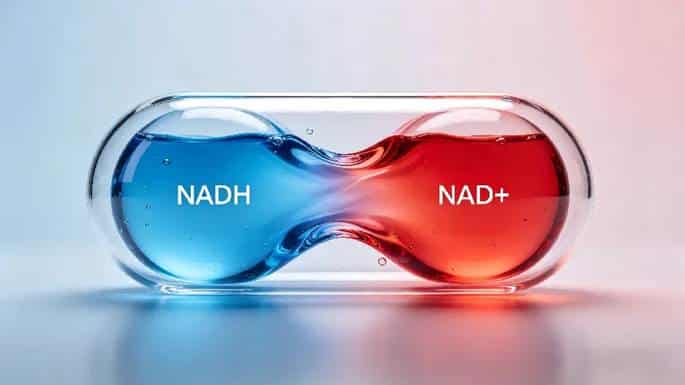
In normal cells, the dynamic balance between NADH and NAD+ is fundamental to efficient energy metabolism. When mitochondrial function is impaired or the tumor microenvironment becomes hypoxic, NADH accumulates intracellularly, disrupting this balance and creating metabolic stress. Normal cells typically cannot sustain this state and undergo cell death. Cancer cells, however, can reroute their metabolic pathways to continuously clear excess NADH, maintaining survival under hostile conditions and even developing drug resistance. The complete metabolic pathway underlying this survival mechanism had not been fully elucidated until now.
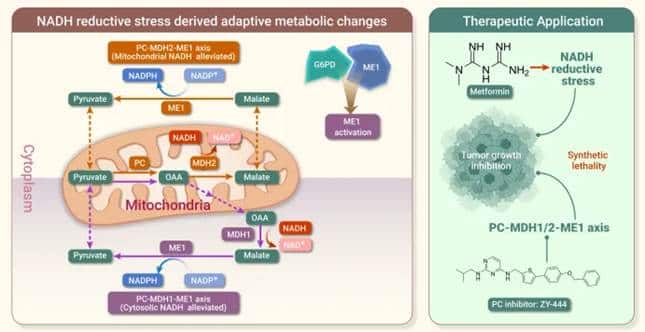
This study confirms that cancer cells possess a collaborative metabolic pathway spanning mitochondria and cytoplasm. Pyruvate carboxylase (PC) serves as the starting point, working in concert with malate dehydrogenase and malic enzyme 1 (ME1) to form an efficient “NADH buffering system.” This system comprises two parallel pathways: one consuming NADH accumulated within mitochondria, and another clearing excess NADH in the cytoplasm. Both pathways ultimately convert surplus reducing equivalents into NADPH, simultaneously relieving the metabolic pressure of NADH accumulation and replenishing materials needed for cellular antioxidant defense, thereby supporting cancer cell survival under stress conditions.
(Source: The Innovation, 2026)
The study also yielded a finding that challenges existing understanding. The metabolic enzyme G6PD (glucose-6-phosphate dehydrogenase), widely recognized for its role in generating NADPH through its own catalytic reaction, was found to perform a function beyond its traditional role in this pathway. The research demonstrates that G6PD can act as a “molecular scaffold,” directly binding to and activating ME1, thereby accelerating the entire NADH conversion pathway. This scaffolding function operates independently of G6PD’s own catalytic activity.
Of particular translational significance, the research team validated the anti-tumor efficacy of targeting this pathway. When the small-molecule compound ZY444 was used to block PC, a key node in the pathway, the NADH buffering capacity of cancer cells was substantially weakened. This sensitized the cells to metformin, a mitochondrial respiration inhibitor, and to CB839, a glutamine metabolism inhibitor. In mouse tumor models, the triple combination of ZY444, metformin, and CB839 exhibited strong synergistic tumor-suppressive effects, with tumor growth significantly inhibited and efficacy far exceeding that of single-agent or two-drug combinations.
This study further clarifies the critical role of NADH metabolic homeostasis in tumor development and progression, and confirms that targeting the NADH buffering pathway represents a promising strategy for oncology research. As follow-up studies advance, combination treatment approaches developed around this mechanism may offer new possibilities for the clinical management of hypoxic and drug-resistant tumors.
References
Li X, Hou P, Zhai X, et al. Metabolic circuitry of NADH buffering reveals a vulnerability in redox-adaptive cancer cells[J]. The Innovation, 2026.
Disclaimer These statements have not been evaluated by the Food and Drug Administration. This product is not intended to diagnose, treat, cure, or prevent any disease.