Redox balance, not the amount of NAD+ a cell carries, is what a study in Science Advances puts at the center of aging. The team engineered fruit flies to express LbNOX, an enzyme that converts NADH into NAD+, and reported longer lifespan, better stress resilience, and restored sleep patterns in aged animals (Yadav et al., 2026).
(Source: Science Advances, 2026)
The work was done in flies, and the tool is not something a person can take. What it does is reframe a familiar question: whether raising total NAD is the right target at all, or whether the balance among NAD+, NADH, NADP+, and NADPH matters more.
Part 01: Redox Balance Is the Part Precursors Cannot Reach
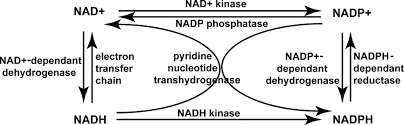
The NAD system is not one molecule but four. NAD exists in cells in an oxidized form, NAD+, and a reduced form, NADH, and both can be phosphorylated into NADP+ and NADPH. Those four molecules form two paired redox couples that sit at the core of energy metabolism and antioxidant defense. As organisms age, the distribution between the two couples shifts, and the authors connect that shift to oxidative stress, reductive stress, mitochondrial dysfunction, lower efficiency of cellular energy production, and a reduced capacity for repair (Yadav et al., 2026).
(Source: Acta Biochim Biophys Sin, 2009)
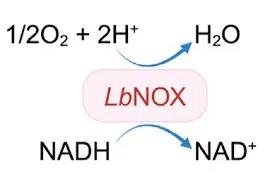
Supplementing precursors such as NMN or NR raises total NAD. It does not set the NADH to NAD+ ratio, it does not allocate molecules between the NAD(H) pool and the NADP(H) pool, and it does not account for the fact that tissues differ. Those three limits are exactly where redox balance becomes the harder and more interesting target. LbNOX, an NADH oxidase from Lactobacillus brevis, converts NADH into NAD+ without generating hydrogen peroxide, and it can be expressed in selected tissues, which is what makes it useful as a research tool (Yadav et al., 2026).
Part 02: What the Tool Changed in Redox Balance
Sex Differences in Redox Balance and Lifespan
Female flies with whole-body expression lived up to 17.9 percent longer in one line, with no measurable change in the total NAD pool and no change in the NADH to NAD+ ratio. Males showed a 6 percent extension under one driver system, together with lower NADH and a lower ratio, while total NAD(H) stayed unchanged. In both sexes, NADPH levels rose significantly and the total NADP(H) pool increased as well. The pool that moved is the smaller of the two, and it is the one that gets measured less often (Yadav et al., 2026).
Redox Balance Moved Without a Change in Total NAD
The lifespan extension here cannot be explained by a bigger NAD pool, because that pool did not change, nor by a lower NADH to NAD+ ratio, because that ratio only moved in males. Adding NR on top of LbNOX did not extend lifespan any further, which suggests the enzyme had already pushed the system into a range where more precursor adds nothing (Yadav et al., 2026).
The finding points at redox balance rather than quantity, at distribution rather than dose. What predicted better outcomes in these flies was where the reducing equivalents sat, not how much NAD the animal carried in total.
(Source: Cell Metabolism, 2024)
Part 03: Redox Balance Under Three Kinds of Stress
Reductive Stress, Oxidative Stress, and Starvation
In a reductive stress model built by expressing mutant alpha B crystallin in the fly eye, strong neuronal death follows, and the same gene carries mutations in humans that are associated with cataract, skeletal muscle weakness, and heart failure. Female flies expressing LbNOX fully reversed the disease phenotype in that model, while males showed partial improvement only and neuronal death was not rescued. The authors suggest the gap comes from sex differences in NAD(P)(H) levels and in the capacity to buffer redox ratios (Yadav et al., 2026).
Under paraquat induced oxidative stress, LbNOX clearly raised survival in females and had a moderate effect in males. That protection tracked with higher NAD(P)H levels and a higher NAD(P)H to NAD(P)+ ratio, which is what effective redistribution between the NAD and NADP pools looks like (Yadav et al., 2026). Under starvation stress, the effect was slight in females and absent in males, which suggests redox balance helps least when the challenge is missing nutrients rather than excess oxidation. Aged flies also climbed better, which is a standard measure of muscle function in this model.
Muscle Specific Redox Balance Outperformed Whole Body Expression
Targeting expression to muscle gave stronger protection against oxidative stress than expressing the enzyme everywhere. A metabolically active tissue turned out to be a better place to intervene than the whole animal, which is the opposite of how precursor supplementation works.
Part 04: Redox Balance in Muscle Resets Sleep in Aged Flies
Aging disrupts sleep architecture, and LbNOX changed that too. Whole body expression repaired the sleep cycle in old flies, and muscle specific expression went further and fully restored sleep pattern, total sleep time, and the fragmentation structure of sleep. That result breaks the assumption that sleep is regulated only by neurons, since redox balance inside muscle tissue appears to reach systemic physiological rhythms, at least in this model.
Neuron specific expression told a different story again. It did not protect against oxidative stress and was harmful in males. It restored total sleep time in aged flies but left the fragmentation parameters unchanged. Tissue specific interventions can produce different outcomes, and occasionally opposite ones, from the same enzyme (Yadav et al., 2026).
Part 05: What Redox Balance Means for a Human Routine
Results in Drosophila do not transfer to people, and the authors make no claim that they do. The NAD network is conserved between flies and mammals, which is why the work is interesting as a direction rather than as an instruction.
Human data do exist for one part of the picture. Skeletal muscle NAMPT protein, the rate limiting enzyme in NAD salvage, was roughly twofold higher in athletes than in sedentary groups and rose 127 percent after three weeks of exercise training in sedentary adults (Costford et al., 2010). NAMPT abundance declines with age in human muscle, and twelve weeks of aerobic or resistance training increased it in both young and older participants (de Guia et al., 2019).
Those trials measured enzyme abundance and muscle related markers. They did not measure lifespan, aging, or any clinical outcome, and no study has shown that raising NAMPT changes how a person ages.
LbNOX itself is a laboratory tool delivered by transgenesis. It is not a supplement, it is not available for human use, and no clinical application exists. Supplies of NMN, NR, or NADH are not equivalent to it, and none of this constitutes a claim about the effect of any commercial product.
Three ideas do carry across, and each one is really a statement about redox balance. Targeting matters more than coverage. Balance among NAD+, NADH, NADP+, and NADPH matters more than the level of any single molecule. And sex specific responses are real enough that a single universal protocol may not fit everyone.
Part 06: Conclusion: Redox Balance Has to Be Measured, Not Assumed
Taken together, the study says the same thing from four directions. Longer life, stress resilience, and sleep architecture in these flies tracked with how reducing equivalents were distributed, not with how large the total NAD pool was. Precursor loading on top of an already balanced system added nothing. Muscle outperformed whole body expression, and neuronal expression did something different again.
None of that makes supplementation pointless, and none of it makes supplementation sufficient. Sleep duration and quality, chronic psychological stress, physical activity, and body composition all sit outside the supplement aisle and all shape the same metabolic network. Two people with the same lab values can be in different states, because redox ratios are buffered differently by sex, by tissue, and by the rest of a person’s metabolism.
References
- Yadav S, Pan X, Li S, et al. Perturbation of NAD(P)H metabolism with the LbNOX xenotopic tool extends lifespan and mitigates age-related changes[J]. Science Advances, 2026, 12(1): eady0628. External Link: https://pubmed.ncbi.nlm.nih.gov/41481756/
- Costford S R, Bajpeyi S, Pasarica M, et al. Skeletal muscle NAMPT is induced by exercise in humans[J]. American Journal of Physiology-Endocrinology and Metabolism, 2010, 298(1): E117-E126. External Link: https://pubmed.ncbi.nlm.nih.gov/19887595/
- de Guia R M, Agerholm M, Nielsen T S, et al. Aerobic and resistance exercise training reverses age-dependent decline in NAD+ salvage capacity in human skeletal muscle[J]. Physiological Reports, 2019, 7(12): e14139. External Link: https://pubmed.ncbi.nlm.nih.gov/31207144/
Disclaimer These statements have not been evaluated by the Food and Drug Administration. This product is not intended to diagnose, treat, cure, or prevent any disease.