celfavor es
celfavor es
Slide

Celfavor® MNMH

Mononucleótido de nicotinamida reducido

Principales ventajas del producto

divider
  • Como forma reducida del NMN y precursor del NAD+, el NMNH se estudia por su capacidad para aumentar los niveles celulares de NAD+ y NADH, así como por sus posibles efectos sobre la función mitocondrial, la respuesta al estrés oxidativo, la reparación del ADN y el metabolismo. Estas propiedades se investigan por su posible relación con la fatiga y los procesos biológicos asociados al envejecimiento.
  • Celfavor® NMNH utiliza tecnología de encapsulación en microesferas diseñada para estabilizar su actividad y abordar la fácil degradación, la descomposición en el medio ácido gástrico y la baja absorción del NMNH. Según los datos experimentales presentados, esta formulación favorece el aumento de los niveles de NAD+ y se investiga por sus posibles efectos sobre el metabolismo y los procesos relacionados con el envejecimiento.
.adv-title { font-size: 42px; color: #004c99; margin: 0 0 8px 0; font-weight: bold; line-height: 1.2; } .adv-divider { display: block; max-width: 520px; width: 100%; margin: 0 0 24px 0; } .adv-list { list-style: none; padding: 0; margin: 0; } .adv-item { display: flex; gap: 14px; margin-bottom: 26px; } .blue-dot { width: 16px; height: 16px; background-color: #004c99; border-radius: 50%; flex: 0 0 16px; margin-top: 8px; } .adv-text { font-size: 18px; line-height: 1.6; color: #333; } /* ===== 手机端适配(767px以下)===== */ @media (max-width:767px){ .adv-title { font-size: 30px; } .adv-text { font-size: 16px; } .adv-item { gap: 12px; margin-bottom: 20px; } .blue-dot { width: 14px; height: 14px; flex: 0 0 14px; } .adv-divider { max-width: 100%; } }
/* 顶部双栏标题 */ .compare-head { display: grid; grid-template-columns: 1fr 1fr; gap: 0; margin-bottom: 0; } .compare-head h2 { font-size: 26px; color: #004c99; padding: 12px 24px; margin:0; } /* 对比主体:逐行布局,每行左右成对 */ .compare-wrap { width:100%; } .compare-row { display: grid; grid-template-columns: 1fr 1fr; gap:0; } /* 单元格基础样式 */ .cell-left { background:#f1f1f1; padding:28px 24px; border-bottom:1px solid #ddd; } .cell-right { background:#e3f0fa; padding:28px 24px; border-bottom:1px solid #cce0ef; } /* 最后一行取消底部边框 */ .compare-row:last-child .cell-left, .compare-row:last-child .cell-right { border-bottom:none; } /* 标题行:图标+文字 */ .item-title { display:flex; align-items:flex-start; gap:10px; margin-bottom:12px; } .icon-cross { font-size:24px; color:#222; line-height:1.1; } .icon-check { font-size:24px; color:#004c99; line-height:1.1; } .item-title h3 { font-size:22px; font-weight:bold; margin:0; } .item-desc { font-size:16px; line-height:1.55; color:#333; margin:0; } /* 移动端自适应单列 */ @media(max-width:767px){ .compare-head, .compare-row { grid-template-columns:1fr; } /* 手机端边框调整 */ .compare-row .cell-left{ border-bottom:0; } } .divider-line { width: 50%; height: 2px; background: #999; margin-top: 50px; }

Limitations of Conventional NMNH

Core Product Advantages

Unstable

Ordinary NMNH has highly unstable chemical properties and is easily oxidized and degraded by light, temperature, humidity, air contact and gastric acid, greatly limiting its wide application.

High stability

Celfavor's patented microsphere technology significantly improves the stability of active ingredients, enabling storage for 36 months at room temperature in the dark without degradation in gastric acid.

Extremely low bioavailability

Easily degraded during room-temperature storage and in the gastric acid environment, unable to reach the intestinal tract for absorption.

High bioavailability

100% stable retention in the stomach, targeted intestinal release; sustained release in the intestine, greatly improving absorption efficiency.

Stable compounding

Suitable for hard capsules, can be compounded with other ingredients

Basic Product Information

divider
ItemDetails
AppearanceLight yellow microspheres
(color customizable upon request)
NMNH content10%
Dosage formCapsule
Recommended dosage10–20 mg/day
(based on NMNH content)
.product-info-wrap { width:100%; } .info-title { font-size:42px; color:#004c99; margin:0 0 8px; font-weight:bold; line-height:1.2; } .info-divider { display:block; max-width:540px; width:100%; margin:0 0 24px 0; } .info-table { width:100%; border-collapse: collapse; font-size:20px; color:#333; } .info-table th, .info-table td { border:1px solid #999; padding:22px 26px; vertical-align: middle; line-height:1.5; } .info-table th { background:#f4f4f4; text-align:left; font-weight:bold; } .info-table td:first-child { width:36%; background:#f4f4f4; font-weight:500; } /* 移动端适配 767px以下 */ @media (max-width:767px){ .info-title { font-size:30px; } .info-table { font-size:16px; } .info-table th, .info-table td { padding:16px 18px; } .info-table td:first-child { width:42%; } .info-divider { max-width:100%; } }

Principales efectos estudiados

divider
1
Aumento eficiente del NAD+: Como nuevo precursor del NAD+, el NMNH se estudia por su capacidad para aumentar los niveles intracelulares de NAD+ y NADH. Los datos experimentales presentados indican un aumento más rápido que el observado con NMN.
2
Mejora de la función mitocondrial: En modelos experimentales, se observó un aumento de la expresión del factor de transcripción mitocondrial Tfam, junto con efectos sobre la función de la cadena de transporte de electrones y el metabolismo energético mitocondrial.
3
Refuerzo de la capacidad antioxidante: En modelos experimentales, se observó un aumento de la expresión del ARNm de enzimas antioxidantes, incluida la glutatión peroxidasa, lo que podría contribuir a reforzar las defensas antioxidantes celulares.
4
Apoyo a la proliferación y reparación celular: En modelos experimentales, se observó la entrada de las células desde la fase G1 hasta la fase S, junto con posibles efectos sobre la capacidad de reparación celular y tisular.
.efficacy-wrap { width: 100%; } .efficacy-title { font-size: 42px; color: #004c99; margin: 0 0 8px; font-weight: bold; line-height: 1.2; } .efficacy-divider { display: block; max-width: 540px; width: 100%; margin: 0 0 26px 0; } .efficacy-list { display: flex; flex-direction: column; gap: 24px; } .efficacy-item { display: flex; gap: 14px; } .num-mark { font-size: 26px; color: #004c99; font-weight: bold; flex: 0 0 32px; line-height: 1.4; } .item-content { font-size: 20px; line-height: 1.55; color: #333; } .item-head { color: #004c99; font-weight: bold; } /* 移动端适配 */ @media (max-width:767px){ .efficacy-title { font-size: 30px; } .item-content { font-size: 16px; } .num-mark { font-size: 22px; flex: 0 0 26px; } .efficacy-list { gap: 18px; } .efficacy-divider { max-width: 100%; } }

Datos experimentales

divider
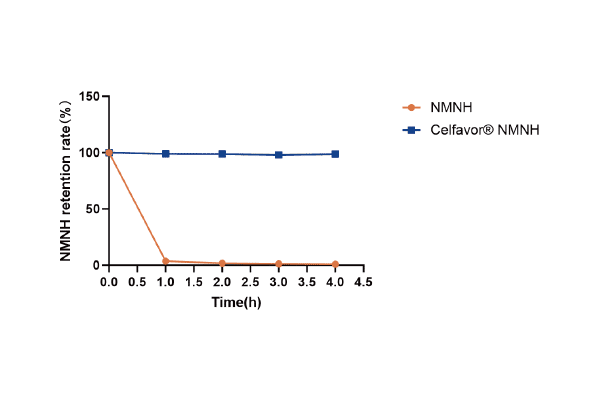
Excellent stability under digestion in simulated

Excelente estabilidad durante la digestión en ácido gástrico simulado con pH 2,0
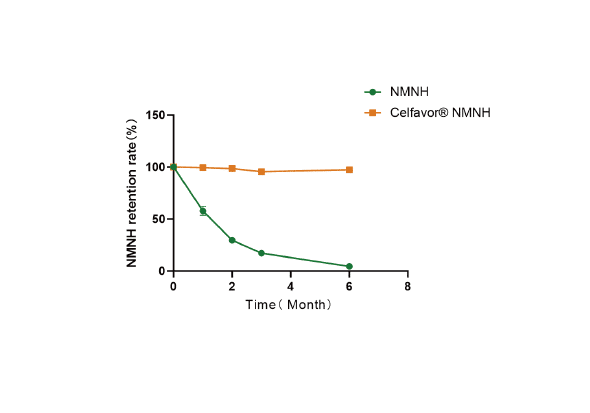
Excellent stability under accelerated

Excelente estabilidad en condiciones aceleradas (37 °C y 75 % de humedad)
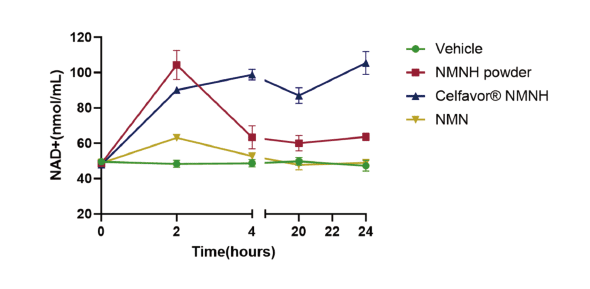
Ratones C57BL/6 machos de 20 g de peso se asignaron aleatoriamente a cuatro grupos y recibieron por vía intragástrica solución salina normal, NMN, NMNH o Celfavor® NMNH, respectivamente, a una dosis de 250 mg/kg.
Se recogieron muestras de sangre de la vena safena lateral a las 2, 4 y 20 horas de la primera administración intragástrica. Veinte horas después se administró una segunda dosis. Cuatro horas después de esta segunda administración, los ratones se sometieron a eutanasia bajo anestesia con isoflurano. Se recogieron muestras de sangre y células epiteliales de los túbulos renales, que se congelaron inmediatamente en nitrógeno líquido.

Efficiency of Celfavor® NMNH in increasing NAD e1784722177725

Eficacia de Celfavor® NMNH para aumentar los niveles de NAD+
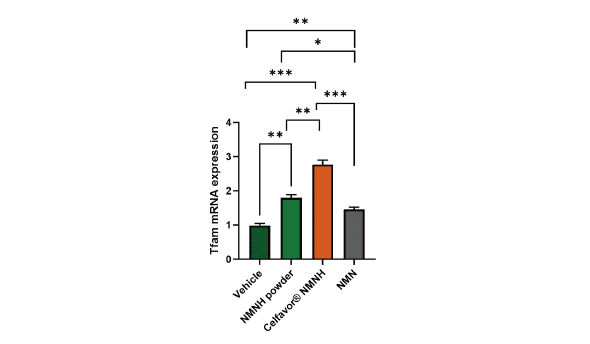
Improve mitochondrial function up regulate e1784722147273

Mejora de la función mitocondrial (aumento de la expresión del factor de transcripción mitocondrial Tfam)

c1002