NADH anti-aging has long been a controversial topic in longevity research, with many misconceptions misleading public health choices. In the anti-aging science community, NAD+ is widely recognized as a star anti-aging molecule. Closely linked to NAD+, NADH has long been misunderstood. Claims such as “supplementing NADH causes accumulation and accelerates aging” and “NADH anti-aging is a waste of money” are widespread, yet they ignore the fundamental logic of cellular metabolism. NAD+ and NADH form a core interactive redox pair, and aging stems from their imbalance rather than the single change of one molecule. With authoritative research data, this article scientifically clarifies the real anti-aging value of NADH and corrects mainstream cognitive biases.
NAD+ and NADH: Indispensable Redox Partners for Cellular Anti-Aging
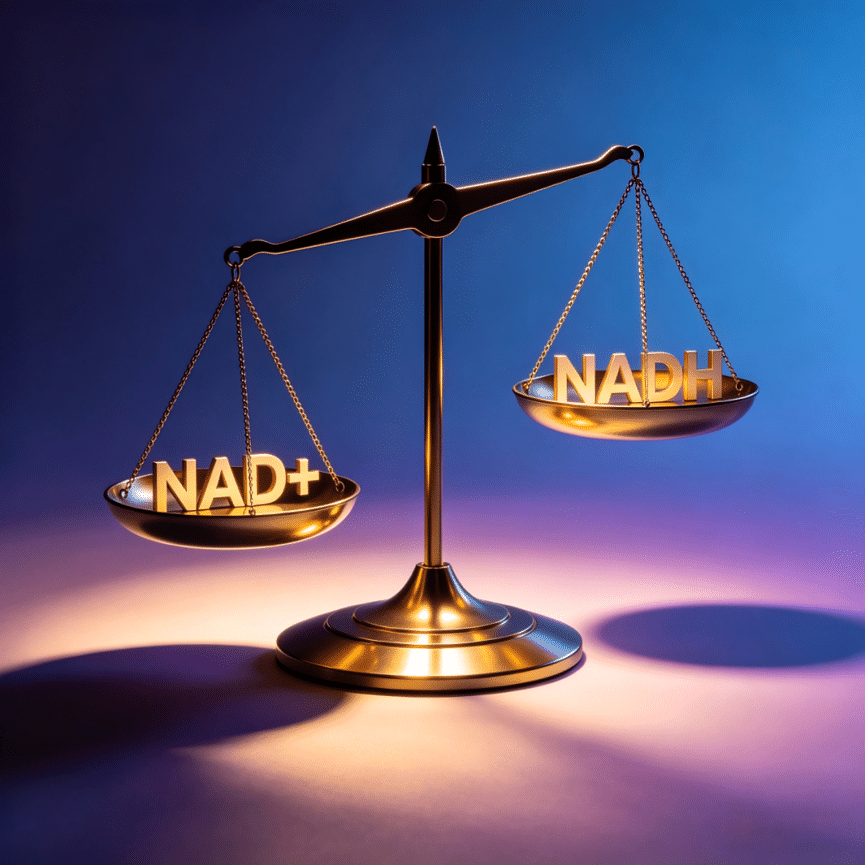
Many people mistakenly regard NAD+ and NADH as two unrelated substances. In fact, they are the core redox pair inside cells, like two sides of a coin, constantly converting to maintain cellular metabolic stability and serving as the cornerstone of cellular energy production and antioxidant defense.
NAD+ is the oxidized form, acting as the master switch of cellular energy metabolism. It participates in thousands of enzymatic reactions, activates sirtuin longevity proteins, and supports DNA repair, making it a core target for anti-aging. NADH is the reduced form of NAD+. Generated by NAD+ reduction, it can convert back to NAD+ after oxidation and acts as a key substrate for mitochondria to produce ATP cellular energy.
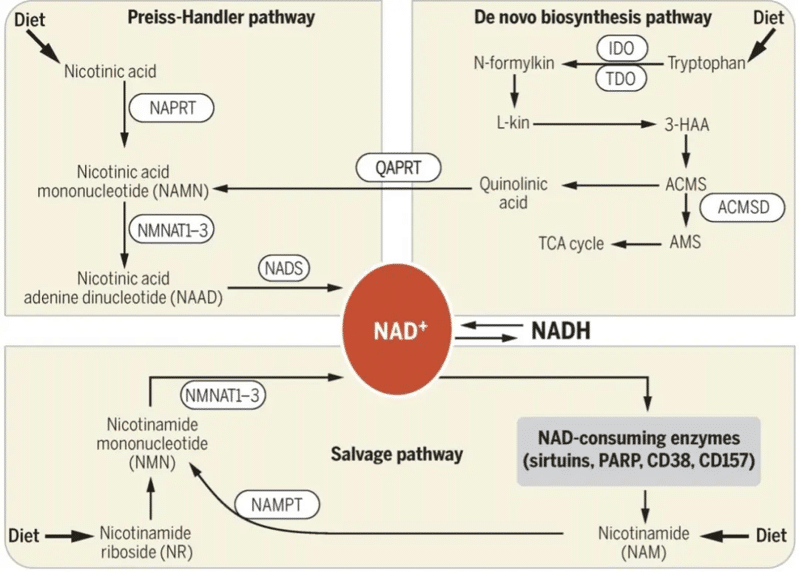
A key rule in healthy cells is that the level of NAD+ is much higher than NADH. The NAD+/NADH ratio directly reflects the cellular redox state and serves as a core indicator to measure cell aging. The essence of aging is the reduced synthesis and increased consumption of NAD+. With age, the activity of NAMPT, the key enzyme for NAD+ synthesis, declines, while consumption enzymes such as CD38 and PARP become more active. This leads to a shortage of NAD+, inhibits sirtuin activity, and forms a vicious cycle of “NAD+ decline → accelerated aging”. NADH plays a critical role in stabilizing this cycle and replenishing NAD+ reserves.
(Source: Science,2015)
NADH Level Changes in Aging: Imbalance, Not Accumulation, Drives Senescence
The main argument against NADH supplementation is that aging elevates NADH levels, and extra supplementation will worsen senescence. However, numerous authoritative studies have confirmed that the changes of NADH and the NAD+/NADH ratio during aging vary greatly across species, tissues and cellular compartments, making a single negative conclusion completely unscientific.
Some one-sided research interpretations claim elevated tissue NADH is linked to aging. A 2006 human study found increased plasma NADH content and NADH/NAD+ ratio among healthy people aged 46 to 78, associating it with reduced ATP production. Such claims confuse total quantity with functional activity and misinterpret raw research data.
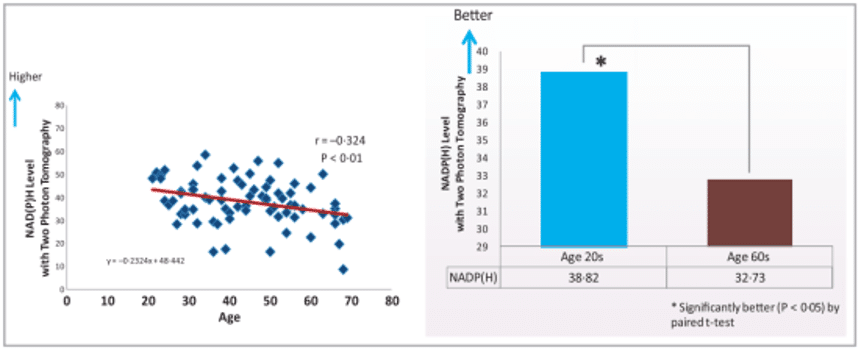
More precise, multi-dimensional research has drawn an opposite and scientific conclusion. At the skin and cellular level, a 2013 Japanese study confirmed that NAD(P)H levels decline significantly in skin keratinocytes of Asian females aged 21 to 68 with advancing age, proving local NADH deficiency in aging skin cells.
(Source:British Journal of Dermatology, 2013)
At the systemic metabolic level, a 2021 German study pointed out that total plasma NAD levels and the NAD+/NADH ratio do not change significantly with age in the human body, negating the universal “NADH accumulation” theory. A 2026 mouse model study further found that the NAD+/NADH ratio changes in opposite directions in the brain of different mouse strains during aging, verifying that judging aging merely by single ratio level is inaccurate.
Current academic consensus confirms that oxidative shift is a typical feature of aging, while moderate reductive shift with relatively sufficient functional NADH can counteract mitochondrial aging. Rather than total NADH quantity, functional free NADH inside neurons matters most. Functional free NADH drops continuously with aging, leading to insufficient energy supply in the mitochondrial electron transport chain, reduced ATP production, weakened cellular autophagy, and accumulation of metabolic waste — the fundamental cause of metabolic decline and accelerated aging. Blaming aging on rising NADH is a fundamental misinterpretation; aging is essentially functional NADH fuel shortage, not excess.
Exogenous NADH: Restoring Metabolic Balance Instead of Causing Accumulation
Public concerns that supplemental NADH leads to over-accumulation and bodily redox disorder confuse raw material supplementation with pathological metabolic imbalance. A large number of cell and animal experiments have overturned this misconception, reaching a unified scientific conclusion: after entering the human body, exogenous NADH is not simply accumulated; it is preferentially directed toward NAD+ synthesis by cellular regulatory systems, restoring natural NAD+/NADH equilibrium.
Multiple authoritative studies have verified this regulatory mechanism. From 2005 to 2007, astrocyte experiments confirmed that exogenous NADH can efficiently enter brain cells. At low doses, it significantly elevates intracellular NAD+ levels rather than accumulating NADH itself. Even slightly elevated NADH at higher doses can be quickly regulated back to a healthy balance by the body’s strong homeostasis mechanism.
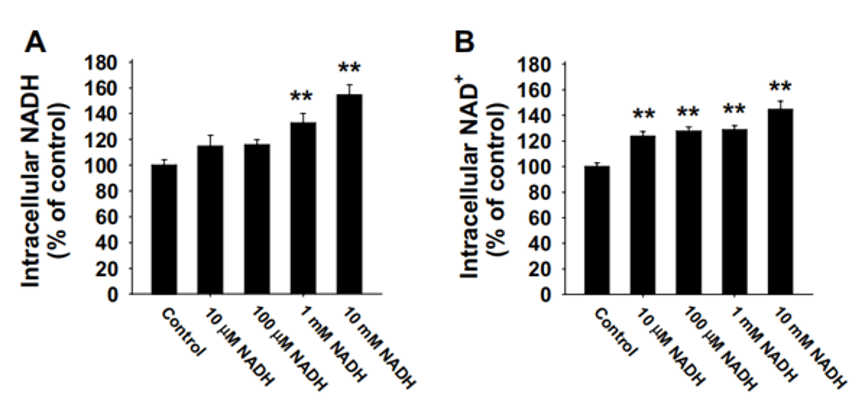
(Source:Biochemical and biophysical research communications, 2007)
Superior Conversion Efficiency
A 2021 hepatocyte experiment further verified the advantages of NADH supplementation: NADH raises cellular NAD+ levels and the NAD+/NADH ratio in a dose-dependent manner, with conversion effects even better than NMN and NRH
Systematic Balance in Living Organisms
Animal experiments provide solid evidence. NADH supplementation elevates NAD+ levels in multiple rat tissues and directly reverses the alcohol-induced decline of liver NAD+/NADH ratio.
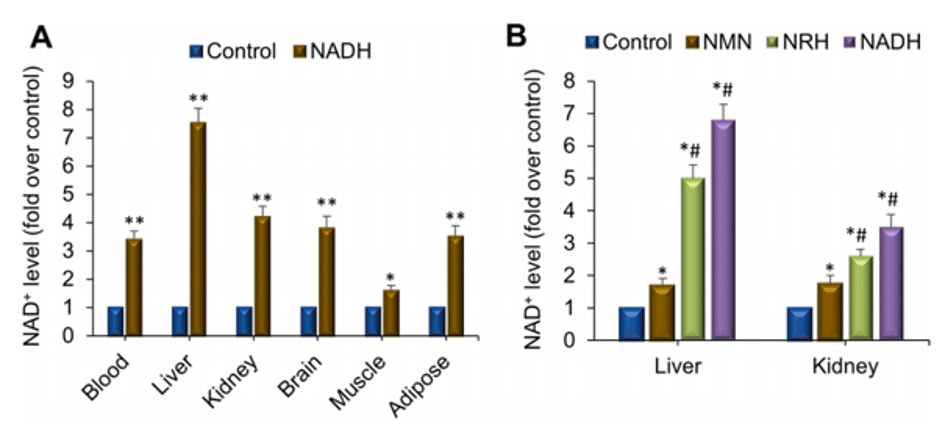
(Source:Journal of Functional Foods, 2021)
It is clear that scientific NADH supplementation acts as an efficient raw material for cellular NAD+ synthesis. Instead of worsening imbalance, it helps aging and damaged cells regain metabolic regulation ability, serving as a powerful approach to slow energy decline at the root.
4. Deep Mechanism: NADH Fights Aging Through Dual Empowerment
NADH anti-aging is not simple “deficiency supplementation”. It follows a sophisticated dual-empowerment mechanism that addresses the two fundamental aging problems: cellular energy shortage and redox imbalance.
First Empowerment: Direct Energy Supply and Intrinsic Protection
As an essential life coenzyme, NADH directly targets aging cell weaknesses in energy supply and oxidative damage. It enters the mitochondrial electron transport chain to boost ATP production, relieving age-related energy deficiency, fatigue and physical decline. As a natural potent antioxidant, NADH scavenges free radicals and protects mitochondrial membranes from oxidative damage. It also enhances cellular autophagy to clear senescent cells and metabolic waste, maintaining a youthful internal cellular environment.