NADH stability is the focus of a 61-page white paper released this week by CELFULL BIO-TECH (USA) on NutraIngredients. Titled “Stable NADH: from Cellular Energy to Healthy Longevity,” it reviews the biology of reduced nicotinamide adenine dinucleotide, the human trials behind it, and the formulation work required to keep the molecule intact from production through to the intestine. The point we make in it is deliberately narrow: what a label declares and what survives to be absorbed are two different numbers.
We chose to publish it on NutraIngredients, which has covered the functional food and supplement industries since 2001 and is read by the audience this work is written for, including brand owners, ingredient suppliers, regulators and researchers. The document is intended for scientific exchange, industry collaboration and channel training. It is not medical guidance, and the cell and animal findings it reviews are not human outcomes.
Part 01: NADH Stability Is the Variable the Category Skipped
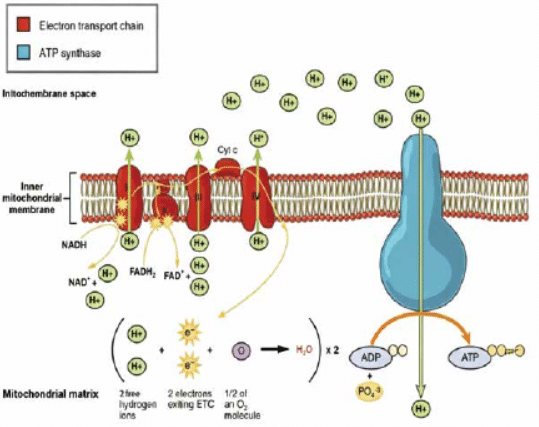
NAD+ reached consumers through its precursors. NMN and NR feed the synthesis network from upstream. NADH sits at the other end of the pair: it is the reduced form, carrying high-energy electrons to Complex I of the mitochondrial electron transport chain, where it hands them off and regenerates NAD+. That cycle is what links nutrient breakdown, mitochondrial respiration and ATP production.
As the category matured, the question shifted. It moved from how much NAD+ a cell holds to how well the pair turns over, and from raising a single number to supporting the conversion process itself. NADH stability is where that question lands, because the molecule is chemically awkward. It degrades under light, oxygen, moisture, heat and acid rather than simply sitting still.
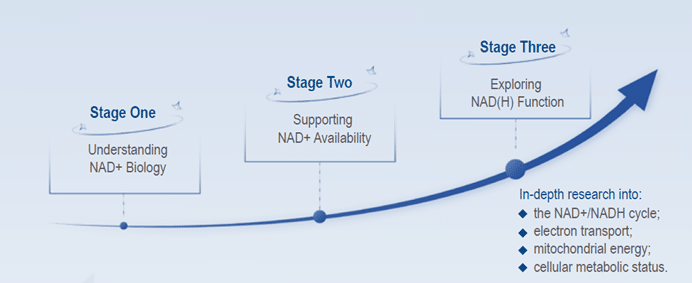
The Three Routes Into the NAD+ Network
Direct NAD+ supplementation remains technically difficult because of the molecule’s properties and the complexity of human digestion. Most commercial attention has gone instead to precursors, which enter the synthesis network through enzymatic steps. NADH is neither: it is the reduced half of the working pair, already carrying the electrons that the chain uses.
What NADH Actually Does
In vitro work on cardiomyocytes found that exogenous NADH was associated with increased intracellular ATP, while NAD+ and nicotinamide did not show the same effect. The NADH to NAD+ ratio reflects cellular metabolic state, and both extremes may disturb metabolism. As we frame it in the white paper, the scientific goal is to support redox homeostasis rather than to push one side of the pair up.
Part 02: What the Human Trials Measured
NADH stability matters only if the molecule does something measurable once it is absorbed, so we kept formulation evidence and human evidence in separate chapters. The human record is smaller than the category’s marketing suggests, and it is worth reading endpoint by endpoint.
Chronic fatigue is the most studied human application. In 207 patients with myalgic encephalomyelitis or chronic fatigue syndrome, 12 weeks of oral NADH at 20 mg/day combined with coenzyme Q10 at 200 mg/day was associated with a significant reduction in perceived cognitive fatigue and with improved health-related quality of life scores measured against baseline (Castro-Marrero et al., 2021). Two qualifications matter: the reported improvement was against baseline rather than a placebo-controlled difference on every endpoint, and NADH was never given alone.
Earlier, a randomized crossover trial in 26 patients found that 8 of 26 responded favorably to 10 mg/day oral NADH, against 2 of 26 on placebo (Forsyth et al., 1999). The authors described it as a pilot and called for a larger study.
Exercise Capacity
A 2025 randomized, placebo-controlled trial assigned 16 healthy untrained men aged 20 to 22 to 40 mg/day sublingual NADH or placebo for three weeks. Estimated work capacity on the PWC170 cycle ergometer protocol rose 25.6 percent and estimated VO2max rose 23.9 percent (Khalid et al., 2025). Sixteen participants is a pilot sample, and blood markers of NADH, NAD+, ATP and phospho-AMPKα1 did not change.
Tolerance
A 2024 systematic review pooled 10 randomized controlled trials covering 489 participants across chronic fatigue syndrome, Parkinson’s disease, Alzheimer’s disease, overweight, postmenopausal prediabetes and older adults. Oral NADH and its precursors were well tolerated, with all reported adverse events mild to moderate, most commonly muscle pain, nervous symptoms, fatigue, sleep disturbance and headache, and with no serious adverse events (Gindri et al., 2024).
Part 03: Where NADH Stability Breaks Down
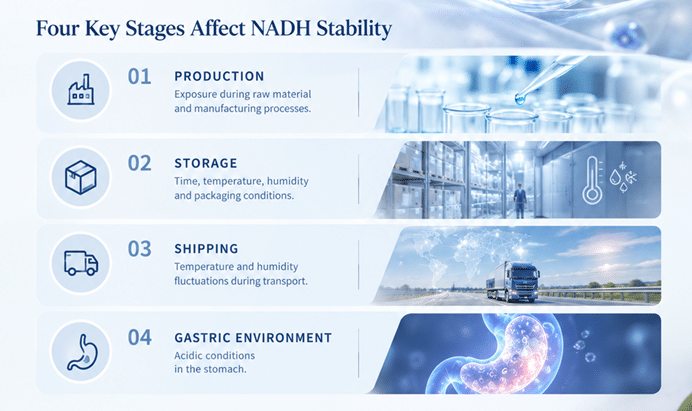
Our argument is simple: NADH stability is lost in four ordinary places, none of them exotic.
Raw materials and production: packaging barrier performance, light exposure, temperature, humidity and storage duration together determine what activity is retained.
Shelf storage: high temperature, humidity and repeated temperature swings accelerate degradation further.
Logistics and transport: exposure to air, moisture and unsuitable temperatures can oxidize or degrade the material before it reaches anyone.
Oral digestion: the strongly acidic gastric environment can break down unprotected free NADH before absorption is possible.
Evaluating NADH Stability: The S-P-R-A Model
We propose four criteria for judging an NADH product. Stability means measurable NADH content under real packaging and storage conditions. Protection means limiting what gastric acid and moisture do to the active ingredient. Release means a reproducible rate at the target site, not merely acid resistance. Assay means validated methods for content, degradation products, batch consistency and release performance.
Across the full chain, the NADH stability testing we recommend runs from initial quality through storage stability, gastric protection and intestinal release to human exposure studies. The last of those is where the industry is thinnest.
Part 04: What NADH Stability Data Does and Does Not Show
CELFULL’s own work on NADH stability rests on three pieces. Green bio-enzymatic synthesis reduces NAD+ using specific dehydrogenases rather than chemical reducing agents, avoiding organic solvent and heavy-metal catalyst residues and giving high stereoselectivity. The TurnA® delivery system applies a four-layer coating: water barrier, oxygen barrier, anti-gastric-acid layer and enteric layer. Celfavor® controlled-release microspheres of 250 to 350 micrometers are built from natural higher fatty alkanol wall materials.
(Turn A® four-layer coating)
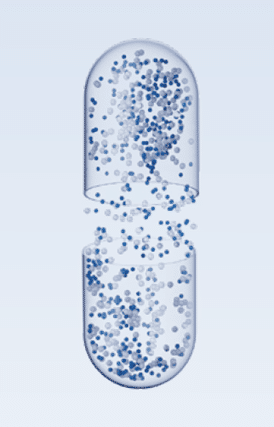
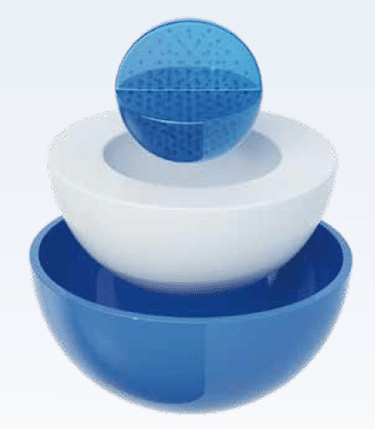
(Celfavor® controlled-release microspheres)
The Reported NADH Stability Numbers
In third-party SGS comparative testing of NADH stability commissioned by CELFULL, unprotected NADH retained about 3.5 percent of activity after six months at 40°C and 75 percent relative humidity, while CELFULL’s Celfavor® microspheres retained about 96 percent. In simulated gastric fluid, unprotected free NADH was reported to lose activity within two hours while the microspheres retained about 98 percent. In simulated intestinal fluid, cumulative release reached about 92 percent within four hours (CELFULL BIO-TECH, 2026). CELFULL also reports 36 months of room-temperature stability and invention patents granted in China, the United States, Japan, South Korea, Australia and Canada.
The Limits of the NADH Stability Numbers
Every NADH stability figure above comes from in vitro simulation or third-party testing that CELFULL commissioned. None of it is a clinical outcome. Celfavor® is our own material, so we have a commercial interest in how those comparisons read, and we think that belongs on the record. A microsphere that survives simulated gastric fluid has demonstrated a formulation property, not an effect in a person. Anyone weighing these numbers is better served by the traceable original test reports than by a summary.
Part 05: What the Evidence Does Not Say
The limits of the NADH stability evidence deserve the same space as the results.
Null Results
A three-month open-label study in 25 patients with mild to moderate dementia found no cognitive improvement from 10 mg/day oral NADH among the 19 who completed it (Rainer et al., 2000). Effects in this category appear to depend on population, disease stage and the endpoint chosen.
Combination Formulas and Design Limits
Two of the largest chronic fatigue trials gave NADH together with coenzyme Q10, so the individual contribution of each component cannot be separated. Several widely cited neurological studies are open-label. One 1993 open-label trial in 885 Parkinson’s disease patients reported clinical improvement in most participants; without a control group such designs carry a high risk of bias, and we present this work as exploratory background rather than as the basis for any product claim (Birkmayer et al., 1993).
Exploratory cell work on AIFM1-related auditory neuropathy found that NADH raised apoptosis-inducing factor dimer levels and reduced apoptosis in neurons derived from patient cells (Qiu et al., 2023). CELFULL also has a registered trial of Celfavor® NADH underway in AIFM1 mutation-positive auditory neuropathy, under registration number ChiCTR2600126425.
Part 06: Conclusion: NADH Stability Is a Measurement, Not a Claim
Three threads on NADH stability run through the document and none of them closes on its own. The human data on fatigue and exercise capacity is real but comes from small trials, several of them combined with coenzyme Q10. The formulation data is real but measures molecules in simulated fluid rather than people. And the null results are real too, which is why one dementia trial found nothing where an earlier open-label study found something.
Persistent fatigue has causes that no supplement addresses. Sleep, sustained stress, mood, thyroid status, iron status, medication and underlying illness all sit further up the list than cellular energy metabolism, and fatigue that lasts warrants evaluation by a clinician rather than a purchase. None of what is reviewed here replaces that.
What we are asking readers to accept is a reordering. The dose on a label is a starting point. What survives to reach the intestine is a measurement, not a claim, and NADH stability is the name for that measurement.
References
CELFULL BIO-TECH (USA) Inc. Stable NADH: from Cellular Energy to Healthy Longevity (NADH & Longevity White Paper on Scientific Research, Technology and Application). October 2026. https://www.nutraingredients.com/Product-innovations/celfull-nadh-healthy-longevity-science-stability-delivery-innovation/
Castro-Marrero J, Segundo M J, Lacasa M, et al. Effect of Dietary Coenzyme Q10 Plus NADH Supplementation on Fatigue Perception and Health-Related Quality of Life in Individuals with Myalgic Encephalomyelitis/Chronic Fatigue Syndrome: A Prospective, Randomized, Double-Blind, Placebo-Controlled Trial[J]. Nutrients, 2021, 13(8): 2658. https://pubmed.ncbi.nlm.nih.gov/34444817/
Forsyth L M, Preuss H G, MacDowell A L, et al. Therapeutic effects of oral NADH on the symptoms of patients with chronic fatigue syndrome[J]. Annals of Allergy, Asthma & Immunology, 1999, 82(2): 185-191. https://pubmed.ncbi.nlm.nih.gov/10071523/
Khalid M, Klymenko O, Dosenko V, et al. Report of a Randomized Placebo-Controlled Trial of the Effects of Oral NADH on Physical Endurance Levels[J]. European Journal of Medical and Health Sciences, 2025, 7(4): 50-60. https://ej-med.org/index.php/ejmed/article/view/2395
Gindri I M, Ferrari G, Pinto L P S, et al. Evaluation of safety and effectiveness of NAD in different clinical conditions: a systematic review[J]. American Journal of Physiology-Endocrinology and Metabolism, 2024, 326(4): E417-E427. https://pubmed.ncbi.nlm.nih.gov/37971292/
Rainer M, Kraxberger E, Haushofer M, et al. No evidence for cognitive improvement from oral nicotinamide adenine dinucleotide (NADH) in dementia[J]. Journal of Neural Transmission, 2000, 107(12): 1475-1481. https://pubmed.ncbi.nlm.nih.gov/11459000/
Birkmayer J G, Vrecko C, Volc D, et al. Nicotinamide adenine dinucleotide (NADH): a new therapeutic approach to Parkinson’s disease. Comparison of oral and parenteral application[J]. Acta Neurologica Scandinavica Supplementum, 1993, 146: 32-35. https://pubmed.ncbi.nlm.nih.gov/8101414/
Qiu Y, Wang H, Pan H, et al. AIFM1 variants associated with auditory neuropathy spectrum disorder cause apoptosis due to impaired apoptosis-inducing factor dimerization[J]. Journal of Zhejiang University-SCIENCE B, 2023, 24(2): 172-184. https://pubmed.ncbi.nlm.nih.gov/36751702/
Disclaimer
These statements have not been evaluated by the Food and Drug Administration. This product is not intended to diagnose, treat, cure, or prevent any disease.