Most anti-aging users care about the accurate NAD supplementation results timeline: how long it takes to see benefits and whether effects rebound after stopping intake. Based on the authoritative 2026 iScience clinical study, this article scientifically reveals the exact onset cycle, steady-state maintenance rule, and post-discontinuation changes of NAD supplementation, solving core doubts for NAD anti-aging enthusiasts.
1. Modern Anti-Aging: Why the NAD Supplementation Results Timeline Matters
In the past, daily nutritional supplementation mainly focused on basic physiological maintenance, relying on vitamins, minerals, and protein nutrients to strengthen physical fitness and maintain bodily functional balance. With the upgrading of nutritional research and anti-aging cognition, modern dietary supplementation has evolved from “physical conditioning” to “cellular anti-aging intervention”. It can effectively delay endogenous aging, reduce age-related disease risks, and comprehensively improve long-term quality of life.
Among numerous anti-aging nutrients, NAD+ stands out as the core scientific solution. As an endogenous small-molecule coenzyme widely present in human cells, NAD+ dominates hundreds of key enzymatic reactions, regulating mitochondrial energy metabolism, cellular redox balance, DNA damage repair, epigenetic stability, and autophagy clearance. Multiple studies have confirmed that human NAD+ levels gradually decline with age. This makes the NAD supplementation results timeline a critical reference for standardized anti-aging supplementation.

2. From Academic Boom to Public Trend: The Rise of NAD+ Anti-Aging
Over the past decade, NAD+ anti-aging research has detonated the global academic community. According to official Google Scholar statistics, more than 10,000 academic papers related to NAD+ were published in 2026 alone, accounting for one-fifth of all global anti-aging research outputs—meaning one out of every five anti-aging studies focuses on NAD+ mechanisms.
This research boom features both quantity and quality. A large number of high-value NAD+ mechanism studies have been published in top-tier journals including Nature, Science, and Cell, forming a complete and rigorous theoretical system for NAD+ cellular anti-aging. Supported by authoritative scientific consensus, NAD+ anti-aging has successfully moved from laboratory theory to public daily health management, becoming a must-have supplementation routine for aging intervention enthusiasts.
3. Individual Differences: Variable NAD Supplementation Results Timeline
Most people who adhere to NAD+ supplementation report positive physical improvements, including relieved physical fatigue, improved concentration and mental clarity, more stable sleep with fewer nighttime awakenings, enhanced exercise endurance, and stronger seasonal disease resistance. However, individual subjective feelings vary greatly among users, lacking unified quantitative standards, leading to widespread confusion about the actual effectiveness of NAD+ supplements.
Unlike subjective physical feedback, scientific research adopts objective detection indicators to judge efficacy. The most authoritative and intuitive evaluation method is to test whole-blood NAD+ concentration after NAD+ supplementation. Whole-blood NAD+ levels integrate free plasma NAD+ and newly synthesized intracellular NAD+ in blood cells, accurately reflecting the body’s overall NAD+ metabolic status and supplementation efficiency.

4. 2026 Clinical Study: Verified NAD Supplementation Results Timeline
A groundbreaking 2026 study published in iScience accurately verifies the authoritative NAD supplementation results timeline and clarifies whether anti-aging effects rebound after stopping intake. This research was completed by the team led by Professor Christian Dölle from the Department of Neurology, Haukeland University Hospital, Norway, focusing on blood and brain pharmacokinetic changes of oral NAD precursor supplementation.
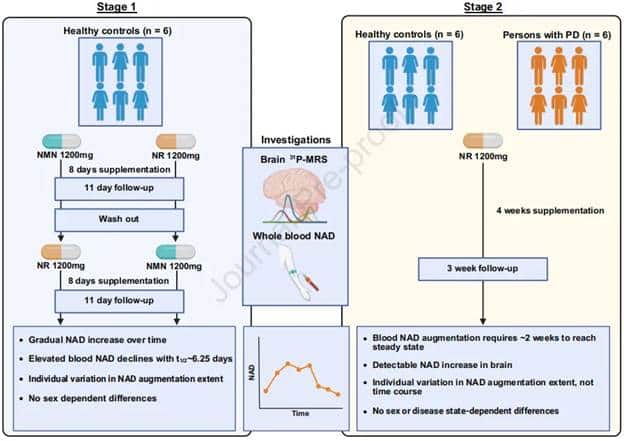
The research team first conducted a 24-hour short-term pilot experiment: a healthy male volunteer took 600mg of NR orally at 0 hours and 12 hours respectively, with whole-blood and brain NAD+ levels detected at 9 time points within 24 hours. The results showed that short-term single and double NR supplementation failed to significantly elevate overall NAD+ levels within 24 hours, though subtle changes in NAD+ intermediate metabolites were observed.
In the subsequent formal long-term intervention experiment, subjects maintained a daily supplementation dose of 1200mg NR or NMN. Rigorous data tracking confirmed the standard NAD supplementation results timeline: continuous intake for 2 weeks is the minimum cycle to build stable blood NAD+ levels and tangible anti-aging effects. After stopping supplementation, blood NAD+ levels decline slowly and return to baseline within 2 to 3 weeks.
The study also confirmed significant individual differences in supplementation efficacy. Although both NMN and NR can effectively boost blood NAD+ levels, NR delivers a more prominent elevation range. Even with the same dosage and cycle, some subjects achieved double NAD+ elevation, while others reached triple growth, fully explaining the varied physical feedback among different users.
More importantly, the study found obvious time thresholds for brain NAD+ improvement. Only 8 days of short-term supplementation with NR or NMN showed no significant changes in brain NAD+ levels. After 4 consecutive weeks of sustainedNAD+ supplementation, researchers detected a substantial increase in brain NAD+ concentrations, proving that brain anti-aging intervention requires long-term persistent intake rather than short-term sporadic supplementation.
5. Scientific Rules to Follow the NAD Supplementation Results Timeline
This latest pharmacokinetic study corrects public misconceptions about the NAD supplementation results timeline and forms three key scientific guidelines for long-term anti-aging supplementation.
First, abandon the “quick-result mentality”. Effective NAD+ elevation requires at least 2 weeks of continuous supplementation to reach a stable physiological state. Only by maintaining persistent intake after steady-state formation can high NAD+ levels be sustained to exert continuous anti-aging effects.
Second, no dependence or irreversible rebound risk exists. NAD+ is an endogenous natural cellular coenzyme without strong pharmacological stimulation. After stopping supplementation, NAD+ levels only slowly return to physiological baseline within 2–3 weeks, and related physical improvements gradually fade accordingly. There is no drug-like dependence or compensatory over-decline rebound phenomenon.
Third, respect individual differences in efficacy. Affected by basal metabolism, gene polymorphism, and cellular absorption capacity, different people show huge differences in NAD+ elevation amplitude and physical feedback. Long-term adherence to standardized supplementation is the core premise of stable anti-aging effects.
6. Conclusion: Standardize Intake With Verified NAD Supplementation Results Timeline
NAD+ anti-aging is a mild, safe, long-term cellular intervention with fixed metabolic cycles. The 2-week steady-state threshold directly determines when stable NAD+ supplementation results appear, while the 3-week regression cycle explains post-stop changes. No dependence or severe rebound aging occurs, fully proving the safety of NAD+ precursor supplements.
For anti-aging enthusiasts, abandoning blind quick-effect expectations, adhering to long-term standardized supplementation, and respecting individual metabolic differences are the keys to maximizing NAD+ anti-aging value. As clinical research continues to advance, the precise supplementation cycle and personalized dosage strategy of NAD+ will be further optimized, bringing more accurate and efficient cellular anti-aging solutions.
References
Berven H, Svensen M, Eikeland H, et al. The NAD-brain pharmacokinetic study of NAD augmentation in blood and brain using oral precursor supplementation[J]. iScience, 2026.