Most people recognize NADH blood flow regulation for its core benefits in anti-aging, antioxidant defense, and energy metabolism. As a key functional molecule in the NAD family, NADH effectively relieves chronic fatigue, boosts mitochondrial energy production, and protects long-term neurological health. However, cutting-edge scientific research reveals a hidden core function of NADH: it acts as the body’s precise blood flow sensor, dynamically matching local blood circulation to tissue metabolic rhythm and maintaining cells in optimal physiological operating status.
1. Core Cellular Role of NADH: The Foundation of Aerobic Energy Metabolism
To understand NADH’s unique blood flow sensing function, it is essential to clarify its core metabolic role in cells. Human cells generate ATP, the body’s direct energy currency, through aerobic glucose respiration, which consists of three key stages: glycolysis, the tricarboxylic acid cycle, and mitochondrial oxidative phosphorylation.
In this complete energy production chain, NADH acts as a critical high-energy electron carrier. During glycolysis and the tricarboxylic acid cycle, NADH continuously captures electrons decomposed from glucose, storing high-energy chemical bonds. In the final oxidative phosphorylation stage, NADH delivers these electrons to the mitochondrial electron transport chain, releasing massive energy to synthesize ATP and support all cellular activities. After releasing electrons, NADH reverts to NAD+, participating in the next round of energy circulation to sustain continuous metabolic operation.

2. NADH Accumulation: The Body’s “Metabolic Emergency Signal”
Under steady daily physiological conditions, NADH production and consumption maintain a dynamic balance. However, intense metabolic demand breaks this equilibrium instantly. During high-intensity exercise, rapid neural activation, or sudden organ functional excitation, cellular ATP demand surges sharply.
At this time, oxygen-independent glycolysis is rapidly activated to produce ATP in a short time. The electron transfer rate from glucose to NAD+ far exceeds the mitochondrial consumption rate of NADH, leading to massive intracellular NADH accumulation. This excess NADH buildup is not a metabolic byproduct—it is an active physiological signal sent by cells to trigger urgent energy and oxygen support.
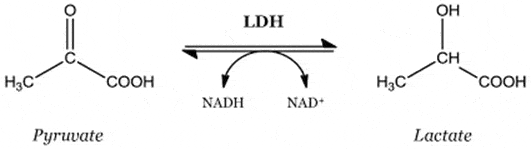
Scientific studies confirm a precise positive correlation between intracellular NADH concentration and the tissue lactate/pyruvate (L/P) ratio. Higher NADH levels elevate intracellular lactate content and raise the L/P ratio. This metabolic signal penetrates the cell membrane and is accurately captured by vascular endothelial cells and smooth muscle cells, forming the core sensing basis of NADH blood flow regulation.
3. Signal Conversion Mechanism: How NADH Sensor Regulates Vasodilation
The L/P ratio fluctuation triggered by NADH accumulation initiates a complete redox signaling cascade to adjust local blood flow. When vascular cells detect an elevated L/P ratio, NADH oxidase is activated to generate superoxide (O₂⁻), which promotes intracellular calcium ion (Ca²⁺) accumulation. The increased calcium level further activates nitric oxide synthase (NOS), stimulating the production of nitric oxide (•NO).
Nitric oxide is a powerful endogenous vasodilator that relaxes vascular smooth muscle, expands local blood vessel diameter, and significantly increases regional blood flow. This process rapidly delivers more oxygen, glucose, and nutrients to high-metabolism tissues, while accelerating metabolic waste clearance, perfectly matching blood supply with cellular energy demand.

4. Animal Experiment Verification: Universal NADH Blood Flow Sensing Ability
Classic rodent experiments published in PNAS and The FASEB Journal have fully verified the authenticity and universality of this mechanism. In visual stimulation tests, rat retina and visual cortex blood flow increased significantly with neural activation. Intravenous lactate infusion—which raises intracellular NADH levels—further amplified blood flow enhancement. In contrast, pyruvate infusion that reduces NADH accumulation effectively suppressed blood flow elevation.
Similar results were observed in skeletal muscle electrical stimulation experiments. Lactate-induced NADH accumulation enhanced blood perfusion in contracting muscles, while pyruvate intervention weakened vasodilation effects. These findings prove that theNADH blood flow sensor mechanism is universal across neural, muscular, and multiple tissue types, achieving precise metabolic-blood flow matching regardless of organ differences.
5. Exercise Physiology Interpretation: NADH Dominates Lactate Metabolism Balance
This mechanism perfectly explains the lactic acid accumulation phenomenon during high-intensity exercise. During strenuous exercise, glycolysis and tricarboxylic acid cycle substrate-level phosphorylation produce ATP far faster than mitochondrial oxidative phosphorylation. NADH generation speed greatly outpaces consumption speed.
To avoid metabolic shutdown caused by excessive NAD+ depletion, lactate dehydrogenase initiates an emergency regulatory strategy: it consumes excess NADH to regenerate NAD+ and converts pyruvate into lactate. The elevated L/P ratio caused by lactate accumulation triggers the NADH blood flow regulation loop: increased local blood flow rapidly clears lactic acid buildup and delivers sufficient oxygen to accelerate mitochondrial NADH consumption.
This forms a self-balancing closed loop of “lactate accumulation → blood flow increase → lactate clearance → metabolic recovery”, effectively maintaining cellular metabolic homeostasis during high-load exercise and delaying physical fatigue.
6. Pathological Significance: NADH Imbalance Triggers Vascular Metabolic Disorders
Beyond daily physiological regulation, the NADH blood flow sensor also plays a key role in pathological intervention. In diabetic patients, persistent hyperglycemia activates the sorbitol metabolic pathway, accelerating abnormal electron transfer to NAD+ and causing excessive NADH accumulation in vascular cells.
Uncontrolled NADH buildup disrupts the normal L/P ratio balance, leading to disordered redox signaling, abnormal vasodilation, and impaired local blood perfusion. This is one of the core underlying mechanisms of diabetic vascular complications. Targeted regulation of the NADH/NAD+ redox balance can correct abnormal vascular blood flow responses, improve microcirculation disorders, and provide an innovative intervention direction for diabetic vascular injury.
7. Conclusion: Redefine NADH’s Comprehensive Physiological Value
NADH’s physiological value extends far beyond traditional anti-aging and energy supplementation. As the body’s inherent precise blood flow sensor, it relies on dynamic NADH accumulation and L/P ratio changes to sense tissue metabolic demand in real time, regulate vasodilation and blood perfusion, and achieve accurate matching between energy supply and consumption.
Whether in daily metabolism, high-intensity exercise adaptation, or chronic disease pathological regulation, the NADH blood flow regulation mechanism maintains whole-body metabolic homeostasis. This breakthrough discovery redefines NADH’s functional positioning, revealing its irreplaceable core role in connecting cellular metabolism and systemic microcirculation, and opening new prospects for metabolic regulation and vascular health maintenance.
References
Ido Y, Chang K, Williamson J R. NADH augments blood flow in physiologically activated retina and visual cortex[J]. Proceedings of the National Academy of Sciences, 2004, 101(2): 653-658.
Ido Y, Chang K, Woolsey T A, et al. NADH: sensor of blood flow need in brain, muscle, and other tissues[J]. The FASEB journal, 2001, 15(8): 1419-1421