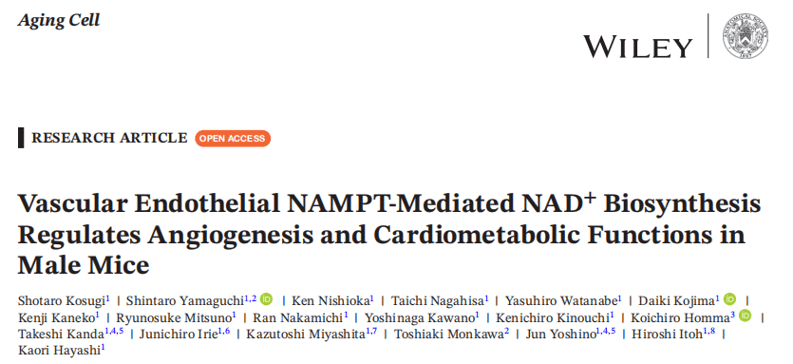
Vascular aging is the subject of a mouse study from Keio University School of Medicine published in Aging Cell. The research team removed the ability to make NAD+ from the endothelial cells that line blood vessels, fed the animals a high-fat diet, and watched angiogenesis falter, blood pressure climb and glucose metabolism deteriorate in male mice. Naturally aged mice developed the same deficit on their own, and nicotinamide mononucleotide, an NAD+ precursor, replenished endothelial NAD+ and improved the measured outcomes (Kosugi et al., 2025).
Every result reported here comes from a mouse model. The endothelium is a thin layer of cells lining every vessel, and it is where this study located the problem. No part of the work measured people. What it offers is a detailed map of the signaling axis that connects NAD+ to vessel flexibility, blood pressure and metabolic health.
Part 01: Vascular Aging Starts in a Single Layer of Cells
Every blood vessel in the body is lined by a thin sheet of endothelial cells. This layer regulates vessel tone, helps prevent clot formation, supports the growth of new vessels and participates in delivering nutrients to surrounding tissue. Vascular aging often begins here, because the endothelium is the interface between the blood and everything the blood supplies.
As the endothelium ages, its behavior changes. Vessels stiffen, permeability increases, inflammatory signaling rises and repair capacity declines. These shifts raise vascular resistance and are associated with the artery stiffening and plaque processes that develop over decades. They are the tissue-level signatures of vascular aging, and they accumulate quietly, which is why the functional signs tend to surface long after the process has been running.
Part 02: The NAMPT to SIRT1 to eNOS Axis Behind Vascular Aging
Three molecules carry most of the story. NAMPT is the rate-limiting enzyme of NAD+ biosynthesis, the narrow step that controls how much NAD+ a cell can make. SIRT1 is a NAD+-dependent deacetylase with well-documented roles in cellular stress responses, and it only works when NAD+ is available. eNOS is the endothelial enzyme that produces nitric oxide, the signal that keeps vessels flexible. Vascular aging, in this framing, is what happens when that chain loses its fuel.
(Source: Aging Cell, 2025)
In the normal chain, NAMPT keeps producing NAD+, NAD+ keeps SIRT1 active, and SIRT1 supports eNOS signaling that drives vessel growth and tone. The study showed that removing NAMPT from endothelial cells breaks this chain: SIRT1 signaling weakens, eNOS signaling follows, and angiogenesis is impaired (Kosugi et al., 2025).
The experiment used mice whose endothelial cells cannot make NAD+ at all, called endothelial-specific NAMPT knockout mice. On a regular diet these animals showed no cardiometabolic abnormalities. On a high-fat diet, the male mice developed reduced angiogenesis, impaired subcutaneous fat formation, impaired glucose metabolism and hemodynamic disturbances (Kosugi et al., 2025).
The Vascular Aging Numbers in Aged Mice
Naturally aged male mice, at an age roughly comparable to a human in their fifties or sixties, showed the same pattern without any genetic modification. NAMPT protein expression in the endothelium fell 29 percent. CD38, an NAD+-consuming enzyme, rose 60 percent. Endothelial NAD+ levels dropped 53 percent, and eNOS phosphorylation fell markedly (Kosugi et al., 2025).
The functional measurements moved in the same direction: insulin sensitivity declined, blood pressure rose, subcutaneous fat mass decreased, and signs of cardiac enlargement appeared. The study frames this as an imbalance between NAD+ production and NAD+ consumption, rather than a simple shortage of supply.
Part 03: Vascular Aging Does Not Hit Both Sexes Equally
The sex difference in this study was pronounced. Female mice with the same endothelial knockout, whether fed the high-fat diet or allowed to age naturally, also showed lower endothelial NAD+ levels, but the decline was smaller than in males. Their eNOS function was largely preserved, insulin resistance barely appeared, and blood pressure rose only mildly.
The authors point to estrogen, which supports endothelial eNOS signaling, as the likely explanation for the difference. That interpretation is consistent with the epidemiological pattern in which women’s cardiovascular risk rises after menopause. It also means the male findings describe a sex-specific route into vascular aging, one that cannot be read as a prediction for women, a boundary the authors themselves draw.
Part 04: Replenishing NAD+ and Vascular Aging Signals in Mice
The intervention arm of the study tested whether the sequence could be pushed in the other direction. Aged male mice received nicotinamide mononucleotide, which the body converts to NAD+ through a pathway that does not depend on NAMPT, at 500 milligrams per kilogram of body weight per day in drinking water for eleven weeks (Kosugi et al., 2025).
What Vascular Aging Rescue Looked Like in Mice
The measured outcomes in these mice moved together: endothelial NAD+ levels recovered, angiogenesis-related gene expression rose, capillary density increased, elevated blood pressure came down, the signs of insulin resistance resolved, and lost subcutaneous fat volume returned (Kosugi et al., 2025).
Two boundaries matter. First, this is animal dosing under laboratory conditions, not a human recommendation of any kind. Second, the improvements were strongest for processes still in motion: NMN did not change cardiac mass or the aortic media-to-lumen ratio at all, and the authors attribute those structural changes to sustained high blood pressure rather than to the NAD+ shortfall itself.
Part 05: Daily Habits That Touch Vascular Aging
The study is mechanistic, but its findings connect to ordinary routines in three places. None of the following is a treatment, and none of it replaces medical care.
Watch the inputs that drain the system. Chronic high-sugar and high-fat eating, ongoing sleep loss and sustained stress all add load to the metabolic machinery the endothelium depends on. A balanced diet, adequate sleep and stress management are the unglamorous baseline.
Know the precursor options and their limits. NMN is the precursor this study used, and NADH is the reduced form of the same pair, which participates in electron transfer and can be converted back to NAD+ in the body. What the trials behind these ingredients have measured so far is limited, and no human trial has measured endothelial NAD+ or angiogenesis outcomes of this kind. The closest human data come from a 12-week randomized, placebo-controlled NMN trial (250 mg/day) that measured arterial stiffness as a secondary endpoint: pulse wave velocity trended lower in the NMN group, but the difference between groups was not statistically significant (Katayoshi et al., 2023).
Men carry more of the exposure in this model. Without the estrogen-linked buffer the authors describe, male vessels were more sensitive to the NAD+ shortfall. Middle-aged men have practical reasons to keep blood pressure and glucose on their screening list, which is a conversation for a clinician rather than a purchase.
Exercise is the habit with human data behind it. Skeletal muscle NAMPT expression is higher in trained people, and sedentary adults showed marked increases after weeks of training (Costford et al., 2010). Twelve weeks of aerobic training, or of resistance training, raised skeletal muscle NAMPT in both younger and older adults, reversing the age-related decline in NAD+ salvage capacity (de Guia et al., 2019). Only NAMPT changed; the other salvage-pathway proteins measured did not. Thirty minutes of brisk walking most days is the version of this that fits a normal week.
Part 06: Conclusion: Vascular Aging Is Cumulative and Measurable
The through-line of this study is that vascular aging, at least in male mice, runs on a supply-and-demand problem. NAMPT-driven production falls with age, CD38-driven consumption rises, the endothelium runs short of NAD+, SIRT1 and eNOS signaling weaken, and the functional signs follow. Replenishing the precursor moved the measured outcomes back in mice whose processes were still in motion.
Blood pressure and glucose levels also have causes no supplement touches. Smoking, sleep quality, chronic stress, genetics, blood lipids and existing medical conditions all sit on the same list, and two people with identical lab values can be in very different situations. Numbers that stay abnormal belong with a clinician, not with a shopping cart.
What the study changes is the address. Vascular aging has usually been discussed at the scale of the artery, the plaque and the decade. This work pulls the question down to a single layer of cells and a single coenzyme pair, and it puts a measurement on the gap between what the endothelium produces and what it consumes.
References
Kosugi S, Yamaguchi S, Nishioka K, et al. Vascular Endothelial NAMPT-Mediated NAD+ Biosynthesis Regulates Angiogenesis and Cardiometabolic Functions in Male Mice[J]. Aging Cell, 2025, 24(11): e70222. https://pubmed.ncbi.nlm.nih.gov/41021357/
Costford S R, Bajpeyi S, Pasarica M, et al. Skeletal muscle NAMPT is induced by exercise in humans[J]. American Journal of Physiology-Endocrinology and Metabolism, 2010, 298(1): E117-E126. https://pubmed.ncbi.nlm.nih.gov/19887595/
de Guia R M, Agerholm M, Nielsen T S, et al. Aerobic and resistance exercise training reverses age-dependent decline in NAD+ salvage capacity in human skeletal muscle[J]. Physiological Reports, 2019, 7(12): e14139. https://pubmed.ncbi.nlm.nih.gov/31207144/
Katayoshi T, Uehata S, Nakashima N, et al. Nicotinamide Adenine Dinucleotide Metabolism and Arterial Stiffness after Long-Term Nicotinamide Mononucleotide Supplementation: A Randomized, Double-Blind, Placebo-Controlled Trial[J]. Scientific Reports, 2023, 13(1): 2786. https://pubmed.ncbi.nlm.nih.gov/36797393/
Disclaimer
These statements have not been evaluated by the Food and Drug Administration. The content of this article is for information only and is not intended to diagnose, treat, cure, or prevent any disease.