NAD+ is an indispensable core coenzyme that dominates cellular redox reactions, energy metabolism, and signal transduction. Its metabolic imbalance is closely linked to multiple chronic diseases and organ dysfunction. While numerous studies have verified that NAD+ precursor supplementation improves tissue repair and metabolic health, the mitochondrial NAD+ liver regeneration regulatory mechanism at the subcellular level has long remained unclear. A landmark December 2025 study published in Nature Metabolism by the University of Pennsylvania research team finally clarifies this core mystery: hepatocyte mitochondrial NAD+ pool capacity is the key limiting factor for liver regeneration, and the SLC25A51 transporter acts as the core switch to control liver repair efficiency.
1. Subcellular NAD+ Compartmentalization: Why Overall Supplementation Cannot Guarantee Liver Repair
Intracellular NAD+ presents strict compartmentalized distribution, forming relatively independent metabolic pools in mitochondria, cytoplasm, and nucleus respectively. Each subcellular NAD+ pool undertakes completely different physiological functions and cannot be mutually substituted. This is the fundamental reason why conventional full-body NAD+ supplementation yields inconsistent liver repair effects.
Previous studies confirmed that systemic NAD+ precursor intake helps improve liver regeneration, but failed to pinpoint which subcellular pool plays a decisive role. Adopting the cutting-edge NAD-SILEC stable isotope labeling combined with subcellular fractionation technology, this 2025 study precisely tracked dynamic NAD+ changes during liver repair. The experimental results clearly show that only mitochondrial NAD+ levels fluctuate highly synchronously with liver regeneration speed; cytoplasmic NAD+ remains stable throughout the repair process with no significant correlation with tissue recovery efficiency.
This breakthrough finding establishes the functional specificity of mitochondrial NAD+ liver regeneration: liver tissue repair relies entirely on sufficient mitochondrial NAD+ supply to support high-intensity energy metabolism and cellular biosynthesis, while cytoplasmic NAD+ cannot compensate for mitochondrial deficiency. It fundamentally explains the limitations of blind NAD+ supplementation and lays a theoretical foundation for precise liver metabolic regulation.
2. SLC25A51: The Exclusive Mitochondrial NAD+ Transporter in Hepatocytes
The mitochondrial inner membrane possesses selective permeability, meaning extracellular and cytoplasmic NAD+ cannot freely enter the mitochondrial matrix and must rely on specific transporter proteins to complete transmembrane transport. Before this study, academia generally speculated that SLC25A47 was the key hepatocyte mitochondrial NAD+ transporter. However, multiple rigorous functional verification experiments in this research completely overturned this conclusion and confirmed SLC25A51 as the sole core mediator.
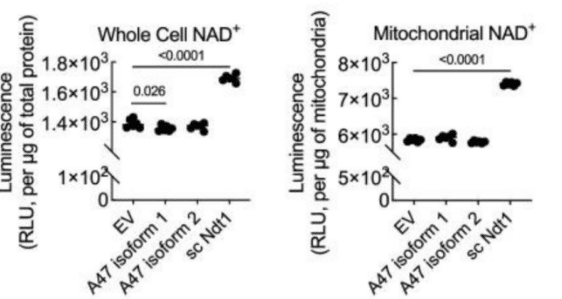
Gene silencing and overexpression cell experiments: In HeLa cells and HepG2 human hepatocytes, silencing SLC25A51 expression significantly reduced mitochondrial NAD+ content. In contrast, overexpressing SLC25A47 produced no noticeable change in mitochondrial NAD+ levels, preliminarily negating the regulatory function of SLC25A47.
Hepatocyte-specific gene knockout animal verification: In SLC25A47 knockout mice, liver mitochondrial NAD+ content remained normal and stable, further proving that SLC25A47 has no NAD+ transport capacity in liver tissue.
Mitochondrial targeted transport activity assay: Using the mitoPARP1cd detection system, researchers intuitively verified that SLC25A51 can efficiently mediate NAD+ entry into the mitochondrial matrix, while SLC25A47 completely lacks this transport activity. This confirms that SLC25A51 expression level directly determines mitochondrial NAD+ pool size and serves as the core regulatory hub of mitochondrial NAD+ liver regeneration.
3. Core Mechanism: How Mitochondrial NAD+ Controls Liver Regeneration Efficiency
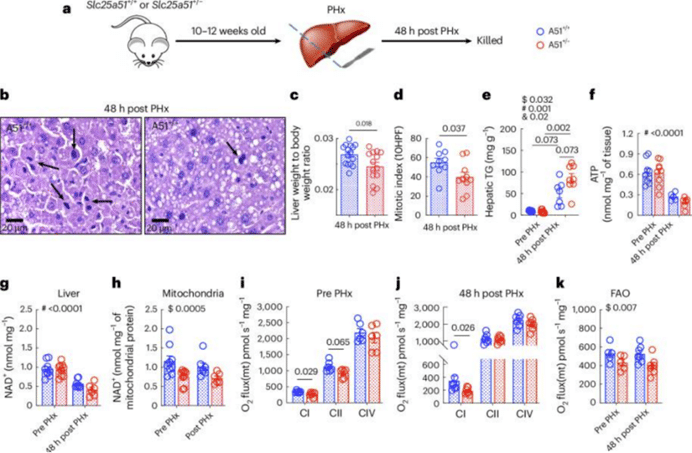
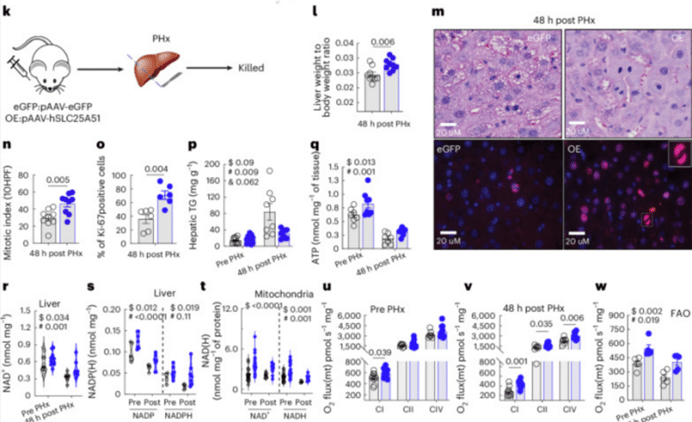
The research team constructed two precise animal models—SLC25A51 heterozygous deletion (Slc25a51+/-) and hepatocyte-specific SLC25A51 overexpression—to systematically elaborate the dual regulatory mechanism of mitochondrial NAD+ liver regeneration covering energy metabolism and lipid homeostasis.
3.1 Insufficient Mitochondrial NAD+ Completely Blocks Liver Repair
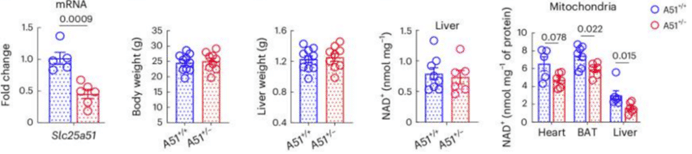
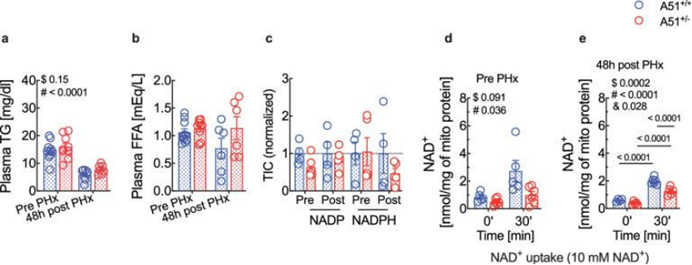
Slc25a51+/- mice exhibited significantly decreased liver mitochondrial NAD+ content, showing severe regeneration defects after partial hepatectomy (PHx). Insufficient mitochondrial NAD+ directly impaired mitochondrial respiratory chain complex I function, reducing fatty acid oxidation efficiency and triggering hepatic energy metabolism collapse. The resulting insufficient ATP production hindered hepatocyte proliferation, leading to delayed liver weight recovery and massive triglyceride accumulation during regeneration. This fully proves that mitochondrial NAD+ deficiency is the core bottleneck restricting liver tissue repair.
3.2 Elevated Mitochondrial NAD+ Significantly Accelerates Regeneration
AAV virus-mediated hepatocyte-specific SLC25A51 overexpression effectively expanded the mitochondrial NAD+ pool, bringing comprehensive improvements in liver regeneration indicators. The elevated mitochondrial NAD+ level activated the PPAR lipid metabolism signaling pathway, upregulated fatty acid synthesis and catabolism-related genes, reduced abnormal lipid accumulation during repair, and maintained stable intracellular lipid homeostasis. Meanwhile, enhanced mitochondrial energy metabolism increased hepatic ATP and nucleoside triphosphate content, sustained high cellular energy charge, significantly boosted hepatocyte mitotic index and Ki-67 positive cell proportion, and greatly shortened liver recovery cycle.
In summary, mitochondrial NAD+ liver regeneration relies on two mutually supportive core pathways: providing sufficient energy power for cell proliferation and optimizing lipid metabolic balance to avoid steatosis-induced repair obstruction.
4. Groundbreaking Clinical Translational Value & Future Research Prospects
This 2025 Nature Metabolism study fills a long-standing gap in subcellular NAD+ liver regulation research and provides multiple innovative breakthroughs for clinical liver disease intervention and NAD+ application optimization.
4.1 Precise New Target for Liver Disease Treatment
SLC25A51-mediated mitochondrial NAD+ transport is defined as the core regulatory pathway of liver repair. Targeted activation of SLC25A51 function can specifically elevate mitochondrial NAD+ levels, offering a new precise treatment strategy for liver injury, cirrhosis, and post-transplant liver tissue repair, breaking the limitations of traditional blind NAD+ supplementation.
4.2 Optimization Direction for NAD+ Precursor Application
The inconsistent clinical efficacy of existing NAD+ supplements stems from their inability to efficiently target mitochondrial NAD+ pools. This study points out a clear optimization direction: developing mitochondrial-targeted NAD+ delivery systems to precisely replenish mitochondrial NAD+, maximize liver regeneration efficiency, and improve the practical clinical value of NAD+ intervention.
4.3 New Biomarkers for Metabolic Liver Diseases
Mitochondrial NAD+ metabolic disorder is closely related to the occurrence and progression of non-alcoholic fatty liver disease, liver fibrosis, and even liver cancer. SLC25A51 expression level and mitochondrial NAD+ pool status are expected to become novel diagnostic biomarkers and therapeutic targets for metabolic liver diseases, supporting early screening and precise intervention.
5. Conclusion: Redefine NAD+ Precision Regulation for Liver Health
For a long time, the public and academia have focused on overall NAD+ levels while ignoring subcellular compartmentalized functional differences. This authoritative 2025 study clarifies for the first time that mitochondrial NAD+ liver regeneration is the decisive core of liver tissue repair, confirms the exclusive regulatory role of the SLC25A51 transporter, and reveals the dual guarantee mechanism of mitochondrial NAD+ in energy metabolism and lipid homeostasis.
This research pushes NAD+ liver health research from “overall supplementation” to “subcellular precise regulation”. With further exploration of the mitochondrial NAD+ metabolic network, it will promote the transformation of NAD+ basic research into clinical precise treatment, bringing more efficient and targeted intervention solutions for global liver disease patients.
References
Mukherjee S, Velázquez Aponte RA, Perry CE, Lee WD, Janssen KA, Niere M, Adzika GK, Lu MJ, Chan HR, Zou X, Chen B, Bye N, Xiao T, Yook JS, Salik O, Frederick DW, Gaspar RB, Doan KV, Davis JG, Rabinowitz JD, Wallace DC, Snyder NW, Kajimura S, Cambronne XA, Ziegler M, Baur JA. Hepatocyte mitochondrial NAD+ content is limiting for liver regeneration. Nat Metab. 2025 Dec;7(12):2424-2437.